
Why Does My Team Bring Every Decision to Me?
How capable leaders unintentionally create dependency, and how to rebuild judgment without abandoning their teams
If your team brings every decision to you, the problem may not be your team.
It may be your leadership.
Not because you’re controlling.
Not because you’re insecure.
But because you’ve become very good at helping.
That’s what makes this pattern difficult to recognize. It doesn’t begin with poor leadership. It begins with good leadership repeated often enough that the organization quietly reorganizes itself around the leader.
One person asks for your opinion.
Then another.
Someone wants you to approve an email. Someone else wants to confirm a conversation before having it. A routine issue becomes a meeting because nobody is certain who should decide.
Eventually, your days become a series of decisions that once belonged somewhere else.
Most leaders respond the same way.
They help.
After all, that’s what leaders do.
Individually, each answer makes sense. Collectively, those answers begin teaching the organization where judgment lives.
The team learns who carries uncertainty. Who settles disagreements. Who is expected to know. Who everyone waits for before moving.
The organization chart may suggest that authority is distributed.
Daily work tells a different story.
People rarely stop using their judgment. They simply learn whose judgment matters most.
Every answer teaches something beyond the question that was asked.
When good leadership begins teaching the wrong lesson
That’s the lesson many leaders never realize they’re teaching.
Dependency rarely begins with weak leadership.
It usually begins with capable leadership.
A leader knows the work. They understand the risks. They’ve seen similar situations before and can often see the path forward long before everyone else.
Helping becomes the obvious response.
And it usually works.
That’s the danger.
The leader answers a question. The work moves forward. The day improves. Nothing appears to have been lost.
But organizations are always teaching people where judgment lives. Every repeated interaction becomes a lesson.
Over time, uncertainty begins travelling to the same place.
Not because people are unwilling to think, but because experience has shown them whose judgment carries the most weight.
I’ve watched this happen in operational environments where mistakes carry real consequences.
A supervisor knows the system, understands the risks and can usually identify the right answer faster than anyone else in the room. Staff begin checking with the supervisor because doing so makes sense. The supervisor responds because helping keeps the work moving.
Nothing about that arrangement initially feels unhealthy.
Until it becomes the normal way of operating.
More questions arrive. Experienced employees begin seeking confirmation instead of exercising judgment. The supervisor spends more time inside daily execution while work that requires a supervisor’s perspective begins to wait.
Eventually, everyone is busy.
The supervisor feels overwhelmed.
The team feels constrained.
Neither side intended the outcome.
The system simply adapted.
Dependence is rarely demanded. More often, it is taught.
The problem is that you’re doing your job
Leaders are accountable.
That matters.
Leadership isn’t about refusing to answer questions or pushing every decision downward. Some situations require immediate direction. Safety events, regulatory risks, serious personnel matters, emergencies and irreversible decisions may properly belong with the leader.
When a serious incident is unfolding, no one benefits from turning the moment into a coaching exercise.
Sometimes the safest and most responsible choice is to decide.
The problem isn’t decisive leadership.
The problem is when emergency leadership quietly becomes everyday leadership.
The exception becomes the habit.
A leader becomes accustomed to stepping in because stepping in works. The issue is resolved. Delay is avoided. The standard is protected.
The immediate benefit is visible.
The longer-term cost is not.
Each intervention reduces the amount of judgment the system must carry. Each answer makes escalation easier the next time. Each rescue strengthens the expectation that difficult work will eventually move upward.
Leaders often feel the immediate cost of delay more clearly than the future cost of dependency.
They choose speed.
The bill arrives later.
How leadership shadows form
Leaders often focus on what they intentionally communicate.
Teams learn just as much from what leaders repeatedly do.
Those repeated behaviours create leadership shadows. People step around them, adapt to them and eventually organize themselves around them.
A leader may say, “I trust your judgment,” while routinely reopening decisions.
They may say, “Take ownership,” while holding standards that remain visible only inside their own head.
They may delegate the work but keep the real authority.
Over time, the spoken message matters less than the experienced one.
Most culture isn’t announced.
It’s observed.
When recommendations are regularly replaced by the leader’s answer, people learn to wait.
When mistakes receive more attention than sound independent decisions, caution grows.
When delegated decisions are routinely revisited, authority becomes theoretical.
When escalation is safer than acting, escalation becomes rational.
Capable people don’t suddenly stop being capable.
They adapt.
So do leaders.
Eventually, the system begins rewarding dependence without anyone intending it.
Support is not substitution
Good leaders support people.
They provide context, answer questions, remove barriers and step in when the consequences exceed someone’s authority or experience.
But support and substitution aren’t the same.
Support strengthens another person’s ability to carry the work.
Substitution carries the work for them.
The difference can be difficult to see because substitution often produces an immediate result. The employee receives an answer. The leader protects the outcome. Everyone moves forward.
Nothing appears to have gone wrong.
The better question isn’t only:
Did my intervention solve the problem?
It’s also:
What did my intervention teach?
Did it help the person think more clearly?
Did it clarify where the edges of their authority are?
Did it make the next decision easier for them to carry?
Or did it teach them that the fastest route through uncertainty is to wait for you?
Sometimes help is an answer.
Sometimes help is context.
Sometimes help is a boundary.
Sometimes help is asking the person to think one step further before the leader enters the decision.
Don’t make people carry authority they don’t have. But don’t carry judgment they’re capable of developing.
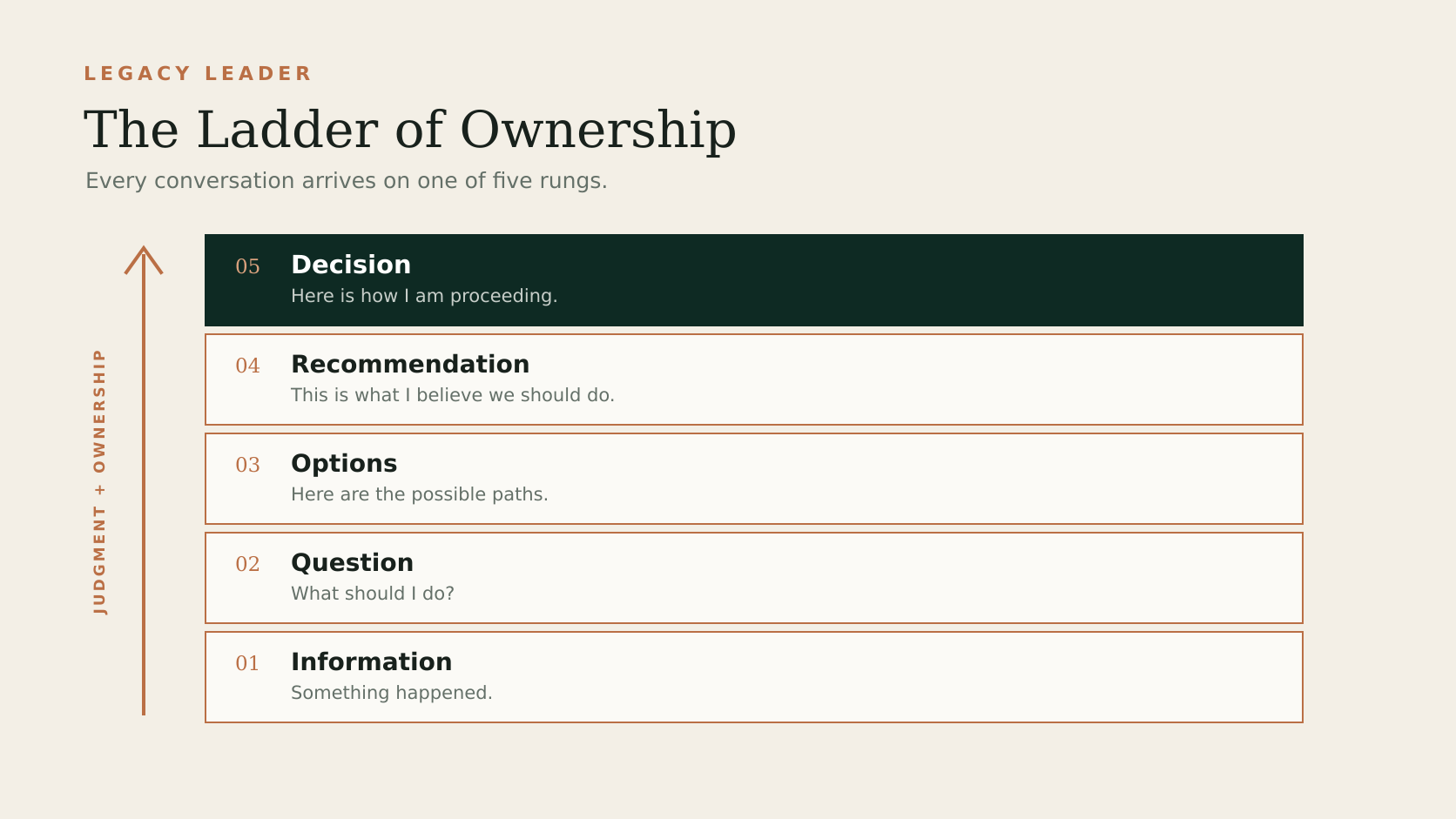
The Ladder of Ownership
Every conversation arrives on one of five rungs.
The higher someone climbs, the more judgment and ownership they’re carrying.
A leader becomes a bottleneck when conversations repeatedly stop on the lower rungs and the remaining thinking moves upward.
The purpose of the Ladder of Ownership isn’t to force every decision downward. Role, experience, risk and formal authority still matter.
Its purpose is to make the transfer of judgment visible.
When someone arrives with information, the leader might ask: “What decision sits underneath this?”
When someone arrives with a question: “What options do you see?”
When someone presents options: “Which do you recommend?”
When someone makes a recommendation: “What authority or support do you need from me?”
The leader’s work isn’t to drag people to the top before they’re ready.
It’s to help them climb one rung higher than they arrived.
That’s how judgment develops without support disappearing.
Why leaders misread dependency
Dependency can look like trust.
People come to the leader early. They seek advice. They follow direction. Problems remain under control because the leader is involved in nearly everything important.
From the outside, the system may look orderly.
From the inside, it may be losing strength.
The clearest test isn’t how smoothly the team operates while the leader is present.
It’s what happens when that leader is unavailable.
Do decisions stop?
Do meetings get postponed?
Do experienced staff wait for confirmation?
Does the same issue receive different treatment depending on whether the leader is involved?
A system that functions well only in the presence of one capable person hasn’t built strength.
It has concentrated it.
That concentration can also feel rewarding.
Being needed feels like evidence of value. Constant involvement creates visibility. Solving difficult problems reinforces competence and status.
A leader may complain about being overloaded while continuing to accept every decision that arrives.
Changing the pattern may require the leader to matter differently.
Leaders often become prisoners of the very habits they created.
Changing the pattern without abandoning the team
A leader who recognizes dependency may be tempted to correct it abruptly.
They stop answering. Send decisions back. Tell people to take ownership.
That usually creates anxiety rather than growth.
A system trained to escalate can’t suddenly carry more authority because the leader has become frustrated.
Dependency is dismantled through redesign, not withdrawal.
People need to know who genuinely owns the decision, when consultation is expected and what must be escalated.
They need visible standards. When quality exists only inside the leader’s judgment, people must keep returning to that leader to discover what good looks like.
They also need the leader to ask for thinking before providing an answer.
“What are you seeing?”
“What have you considered?”
“What do you recommend?”
“What would you do if I were unavailable?”
Those questions shouldn’t become a ritual for withholding help. Their purpose is to return appropriate judgment to the person closest to the work.
Leaders must also distinguish between decisions that are reversible and those that aren’t.
A reversible decision can often be corrected. It may be a reasonable place for someone to practise judgment.
An irreversible decision with serious consequences may need greater involvement.
Treating every choice as equally dangerous creates unnecessary control.
So does protecting people from every manageable mistake.
Judgment develops through use. Sometimes people will choose differently than the leader would have chosen. Sometimes the result will be imperfect.
That doesn’t automatically mean the decision should have stayed with the leader.
The question is whether the person acted within clear boundaries, thought responsibly and learned from the result.
Stepping back doesn’t mean disappearing.
People need to know that the leader will remain available, especially when a reasonable decision produces an unexpected outcome.
Without that support, judgment will quickly travel upward again.
The short-term cost of building judgment
Developing ownership is often slower at first.
It takes longer to ask someone for their reasoning than to provide the answer.
A person learning to decide may need context, discussion and follow-up. Their recommendation may not be as polished as the leader’s. They may choose a reasonable path the leader wouldn’t have chosen.
That discomfort is part of the work.
Capable leaders struggle here because they can see the faster route. They know they could resolve the issue in minutes.
But leadership can’t be measured only by how quickly today’s problem disappears.
It must also be measured by what the organization will be able to carry tomorrow.
The leader who answers everything may appear highly effective.
The leader who develops judgment may appear slower for a time.
Only one is building capacity that can endure.
What your answers leave behind
Every time a leader answers a question, more than one decision is being made.
The immediate decision may concern a schedule, a customer, a conflict, a risk or the next step in the work.
Beneath it sits another question:
Who will carry judgment the next time this happens?
When leaders answer too quickly, they may solve today’s problem while preserving tomorrow’s dependency.
When they slow the conversation down, ask for thinking and allow others to carry appropriate decisions, the immediate process may take longer.
But something more durable is being built.
A person becomes more capable.
A role becomes clearer.
Authority moves closer to the work.
The organization becomes less dependent on one person’s availability.
Every leader eventually leaves.
Retirement.
Promotion.
A new opportunity.
Illness.
Sometimes without warning.
The only question is what remains after they do.
If every important decision still depends on your judgment, your departure leaves uncertainty behind.
If your leadership has developed judgment throughout the organization, people continue making sound decisions long after your office is empty.
Leadership is not measured by how many answers you have. It is measured by how much judgment you leave behind.
That isn’t simply better delegation. It’s stewardship.