
What Happens When an Organization Uses Up Its Leaders?
How stacked roles, unfilled vacancies, and constant change quietly remove leadership capacity
Identifying details have been altered or withheld to protect the people and organization involved.
A leader can be a good person and still leave an organization unprepared.
An organization can value a leader and still consume the capacity that made their leadership useful.
Both can be true at the same time.
I worked for a manager who was widely regarded as a good man. He was friendly, social, and approachable. He made a point of greeting people in the morning. He knew how to put others at ease, and people generally liked him.
Then the organization changed his job without changing his title, pay, or available capacity.
He retained responsibility for the function he already led and inherited a second, substantially larger area after another manager left. The new portfolio brought unfamiliar people, finances, operating systems, documentation, risks, and relationships. His workload didn’t simply increase. The nature of the work changed around him.
Several years later, he was also given a major transformation initiative.
From the outside, he remained the same friendly manager. From inside the system, something more important was disappearing.
Leadership presence.
One of his long-serving direct reports described the change to me with uncomfortable clarity. I’m paraphrasing:
At first, I had a manager. Then I had part of one. By the end, I had almost none.
The manager was still employed. His accountabilities still appeared on an organization chart. Meetings still happened. Decisions were still made.
But the amount of leadership available to the people below him had been steadily reduced.
I felt that reduction directly. I was usually given one hour a month with him, when the meeting wasn’t cancelled. By then, a month’s worth of unresolved matters had accumulated. The hour was consumed by operational needs that couldn’t move because a decision or agreement was stuck at his level.
As his capacity narrowed, he also moved further into decisions that belonged within my role. The less time we had to establish context and direction, the more individual operational choices were drawn upward. Lunch meetings were occasionally added because there was nowhere else to put the conversation, but an improvised hour over lunch couldn’t replace regular leadership access.
During one staffing cycle, several approved positions in my area remained vacant. He wanted to resolve broader structural questions before allowing the hires and repeatedly said he needed to bring the relevant leaders together. The meeting never happened. I couldn’t fill the positions, the original rationale for them weakened with time, and the organization now risked concluding that positions we hadn’t used were positions we hadn’t needed.
The cost didn’t disappear. It moved to staff who were already overloaded. Their overwork generated more operational pressure, which created more matters needing managerial attention, which further reduced the time available for direction, development, and staffing decisions. The system had begun feeding its own scarcity.
I asked for more time. His response was, “Everyone is important.” The statement was fair in principle, but importance without allocated attention changes nothing. From where I sat, the function remained accountable for results while receiving too little managerial capacity to resolve what kept accumulating.
That distinction matters. Social warmth and leadership presence aren’t the same thing. Warmth helps people feel welcome. Leadership presence requires enough capacity to notice what is changing, make sense of complexity, develop others, transfer judgment, and prepare the system for what comes next.
He eventually retired after carrying that arrangement for years.
After he left, the direct report who had known him longest said something that should stop any organization in its tracks. Again, I’m paraphrasing:
I don’t know what he did. I wasn’t trained to do it. I don’t know how to lead now.
This wasn’t a new employee. It was an experienced senior leader near the top of their abilities. Yet critical knowledge hadn’t been transferred, readiness hadn’t been tested, and the work of leadership hadn’t been made visible enough to inherit.
The organization had received years of output from its manager. It hadn’t secured continuity.
The part that belongs to the leader
It would be easy to make the organization the villain and the manager the victim. That would be incomplete.
Leaders have a stewardship obligation. They’re responsible not only for today’s decisions, but also for developing people, sharing context, documenting critical work, testing successors, and leaving behind a system that can function without them.
That work didn’t happen adequately.
Overload helps explain why. It doesn’t erase the consequences.
A leader approaching the end of a career should be able to answer some basic questions:
- Who understands the decisions I make that aren’t visible in a procedure?
- Who has practised carrying this level of judgment?
- What relationships, commitments, and risks exist only in my memory?
- If I left sooner than expected, what would become uncertain immediately?
Good intentions are not a succession plan. Longevity is not knowledge transfer.
Being available when asked isn’t the same as deliberately preparing someone to continue the work.
Every leader eventually leaves. Stewardship requires treating that fact as a present responsibility, not an end-of-career administrative task.
The part that belongs to the organization
Individual responsibility is only part of the analysis.
The organization had taken one full leadership role, added responsibility for another major function, and later assigned transformational work on top. It had converted one person’s willingness to carry more into a long-term operating model.
That’s how leadership capacity is often consumed. Rarely through one reckless decision. More often through a sequence of reasonable-sounding choices:
- Hold the position vacant for now.
- Ask a capable leader to cover it temporarily.
- Leave the leader’s original responsibilities in place.
- Add a strategic project because that leader knows the organization.
- Reassess the structure after the next budget, reorganization, or planning cycle.
Each decision can be defended on its own. Together, they remove leadership from the system.
The work doesn’t vanish when a position remains vacant. It moves. Some of it travels upward. Some is pushed downward. Some is carried informally by people without the authority or context to do it well. Some is postponed. The least visible work, coaching, reflection, relationship maintenance, risk sensing, and succession, often disappears first.
The organization chart continues to show coverage.
The lived organization experiences absence.
An organization can retain accountability on paper long after it has removed the capacity needed to exercise it.
I first understood the problem too narrowly
After the manager retired, the organization didn’t replace the role. Instead, it placed another operational leader into a more senior acting assignment while leaving much of that person’s existing portfolio intact.
I was disappointed to lose out on an appointment I applied for.
I initially understood it as a judgment about who was considered capable and who wasn’t. I questioned the choice and compared the person selected with others who might have carried the role. My reaction was personal because leadership appointments are never merely structural to the people living beneath them. They affect status, opportunity, authority, and whose judgment the organization appears to trust.
But as the arrangement unfolded, the larger problem became harder to ignore.
The acting leader was expected to carry responsibilities from multiple levels at once including that of the manager who wasn’t expected to be replaced for the better part of a year. Then a major modernization initiative was added to their portfolio. Early contact with the leaders below him quickly thinned. Time for conversation, direction, and development became scarce. Routine connection became difficult.
The organization had created a role that would make almost anyone less present.
It hadn’t learned from the previous manager’s experience. It had repeated the same design: preserve the accountabilities, stack the roles, add change work, and depend on personal endurance to close the gap.
The organization hadn’t replaced its manager. It had distributed the missing work among people who were already fully employed.
Leadership capacity disappears before performance does
This pattern is difficult to confront because organizations can continue producing for a long time after leadership capacity begins to erode.
Reports are submitted. Operational decisions are made. Emergencies are handled. Meetings stay on the calendar. Capable people compensate because they care about the work and don’t want the system to fail.
Visible performance becomes evidence that the arrangement is working.
It may be evidence that people are absorbing the cost.
Sustained overload rarely announces itself with an immediate collapse. It appears first as a reduction in leadership depth:
- Conversations become shorter and more transactional.
- Decisions address the immediate issue but not the pattern beneath it.
- Direct reports receive assignments without the context that would develop judgment.
- Coaching is delayed until there’s more time or never happens at all.
- Succession becomes a name on a chart rather than demonstrated readiness.
- Strategic work crowds out relational work, even though both require the same leader.
- Sick days, irritability, withdrawal, or reduced availability are treated as individual matters rather than capacity signals.
The leader may still be committed. They may still be competent. They may still work extraordinary hours.
Capacity isn’t the same as motivation. A person can care deeply and still lack the time, attention, and internal margin to lead well.
This is where organizations often make a serious error. They see that the leader hasn’t dropped anything visible and conclude that nothing has been lost.
But leadership isn’t only the work that gets completed. It’s also the capacity created in others, the risks noticed early, the conflicts repaired, the decisions improved, and the continuity built before it’s needed.
When those functions disappear, management may continue while stewardship stops.
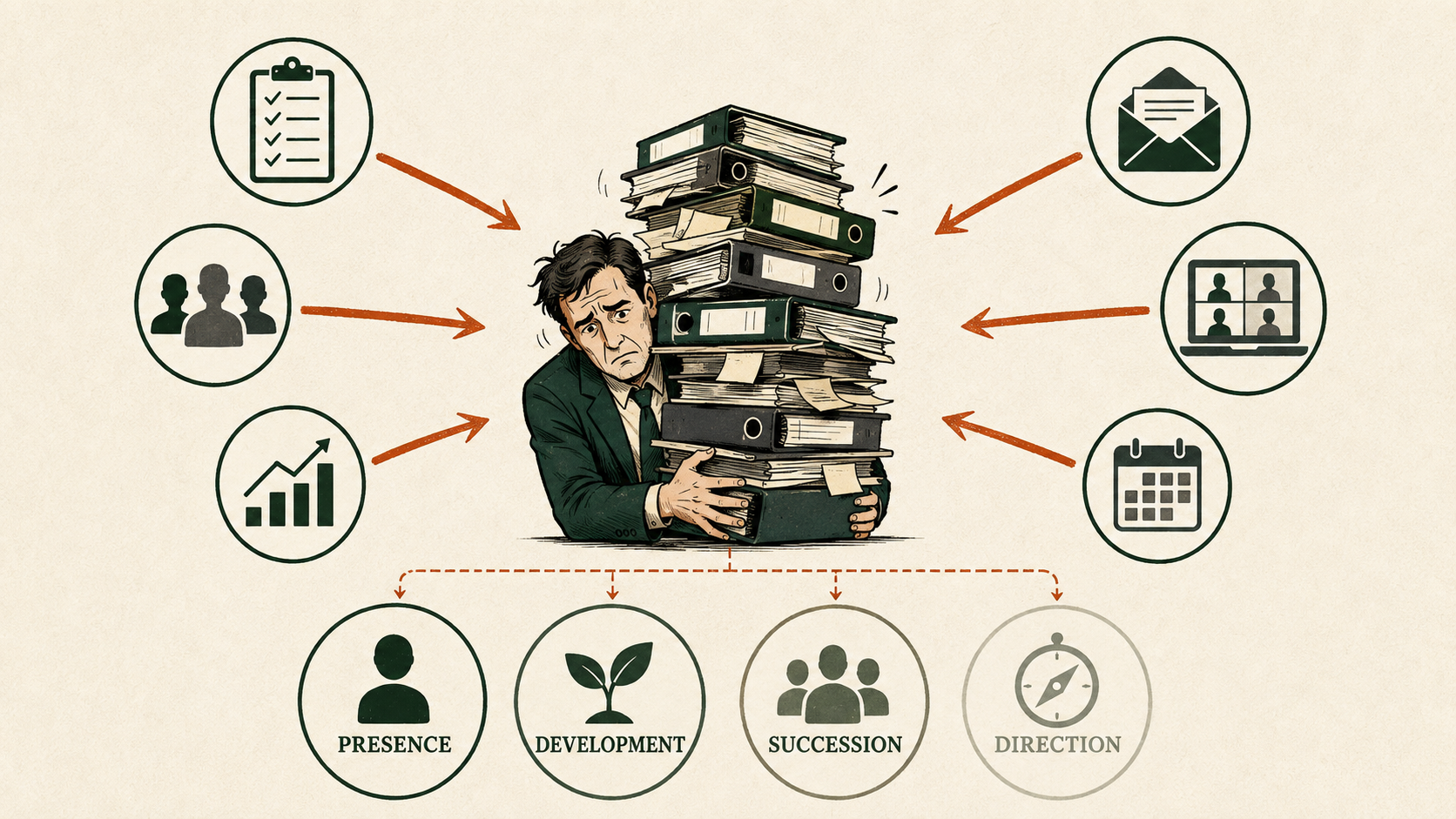
Four signs an organization is using up its leaders
The pattern becomes clearer when examined through four losses.
- 01
Presence disappears
The leader remains accountable but becomes increasingly unavailable. Contact is compressed into approvals, escalations, and urgent decisions. People may still see the leader, but they have less access to the leader’s attention.
Presence isn’t measured by how often someone attends a meeting. It’s measured by whether the leader can still hear complexity, notice weak signals, and remain with an issue long enough to understand it.
- 02
Development stops
When capacity narrows, leaders default to execution. They answer, fix, approve, and move on because development takes more time in the moment.
Direct reports continue doing their current jobs but receive little exposure to the work above them. They may be dependable for years without ever being asked to practise the judgment, relationships, or ambiguity their leader carries.
The result is predictable. When the position opens, tenure is mistaken for readiness, or the organization discovers that no one is prepared.
- 03
Succession becomes assumption
Organizations often point to experienced people beneath a leader and assume continuity exists. Experience matters, but proximity doesn’t automatically transfer knowledge.
A successor needs more than files and introductions. They need access to decision logic. They need to understand why priorities were set, where informal commitments exist, which risks haven’t yet surfaced, and how the role responds when competing obligations can’t all be satisfied.
Succession planning focuses on replacing a person. Endurance requires replacing dependency.
- 04
Vacancies become workload strategies
An acting assignment can be useful when it has a clear mandate, bounded duration, removed responsibilities, and enough support. It becomes destructive when it’s used to avoid a staffing decision while preserving every expectation.
If the person retains the old role, inherits the vacant one, and receives strategic work on top, the organization hasn’t created coverage. It has created concealed scarcity.
Temporary arrangements become especially dangerous when there’s no decision date. The leader’s extraordinary effort slowly becomes the new baseline.
Organizations rarely use up leaders in one dramatic act. They do it by converting temporary overload into permanent structure.
A practical leadership capacity review
This issue can’t be reduced to a wellness conversation. Rest matters, but no amount of personal recovery can correct a role designed around multiple sets of accountabilities.
Leaders and organizations need to examine the same four areas from different sides.
Presence
For the leader: What leadership work has quietly disappeared from my calendar? Who receives only the remainder of my attention?
For the organization: Are leaders available for the work only they can do, or merely reachable for urgent approvals?
Development
For the leader: Who is learning the work above their current role? Where are they being allowed to practise judgment before a vacancy forces the issue?
For the organization: Do acting and developmental assignments include coaching, authority, exposure, and relief from existing duties?
Continuity
For the leader: What knowledge, relationships, and decision logic still depend on my memory or presence?
For the organization: If this leader left unexpectedly, what would slow, stop, or become uncertain within thirty days?
Structural honesty
For the leader: Have I clearly named the capacity risk, or have I protected the organization from seeing it by continuing to absorb the load?
For the organization: Does the organization chart show actual leadership capacity, or only accountabilities assigned to names?
The purpose of these questions isn’t to prove that leaders are busy. Most organizations already know that.
The purpose is to identify what the busyness has displaced.
What stewardship requires now
The first responsibility is to stop calling chronic arrangements temporary.
If a vacancy will remain open, the organization should decide explicitly which work will stop, which responsibilities will move, what authority will accompany them, and when the arrangement will be reviewed. Adding accountability without removing work is not prioritization.
The second responsibility is to make succession active. Potential successors need real exposure to higher-level judgment while the current leader is still present. They need to lead meetings, carry difficult decisions, manage cross-functional relationships, and receive feedback on work that can’t be learned from a procedure.
The third responsibility belongs to overloaded leaders themselves. They must resist making extraordinary endurance look sustainable. Quietly absorbing unreasonable load may feel loyal, but it hides the structural decision from the people accountable for making it. Raising capacity risk isn’t a failure of commitment. It’s part of stewardship.
Finally, senior leaders must distinguish between assigning work and creating capacity. A new title doesn’t create time. An acting appointment doesn’t create readiness. A high-level strategic project doesn’t pause operational responsibility simply because the work is important.
Capacity has to come from somewhere.
If it isn’t added through staffing, authority, time, development, or removed work, it will be extracted from attention, health, relationships, judgment, and continuity.
The extraction may remain invisible for years.
Then someone retires, resigns, becomes ill, or simply reaches the limit of what they can carry. The organization looks around for the next leader and discovers that it hasn’t been developing one. It’s been using up the people it already had.
Every leader leaves eventually.
The measure of stewardship isn’t how much the leader managed to carry before leaving. It’s whether the people and the system are stronger, clearer, and more capable after they’re gone.
Leadership is temporary. What it teaches the system can last much longer.